Battery containers
ChargeBlock
Large-scale energy storage
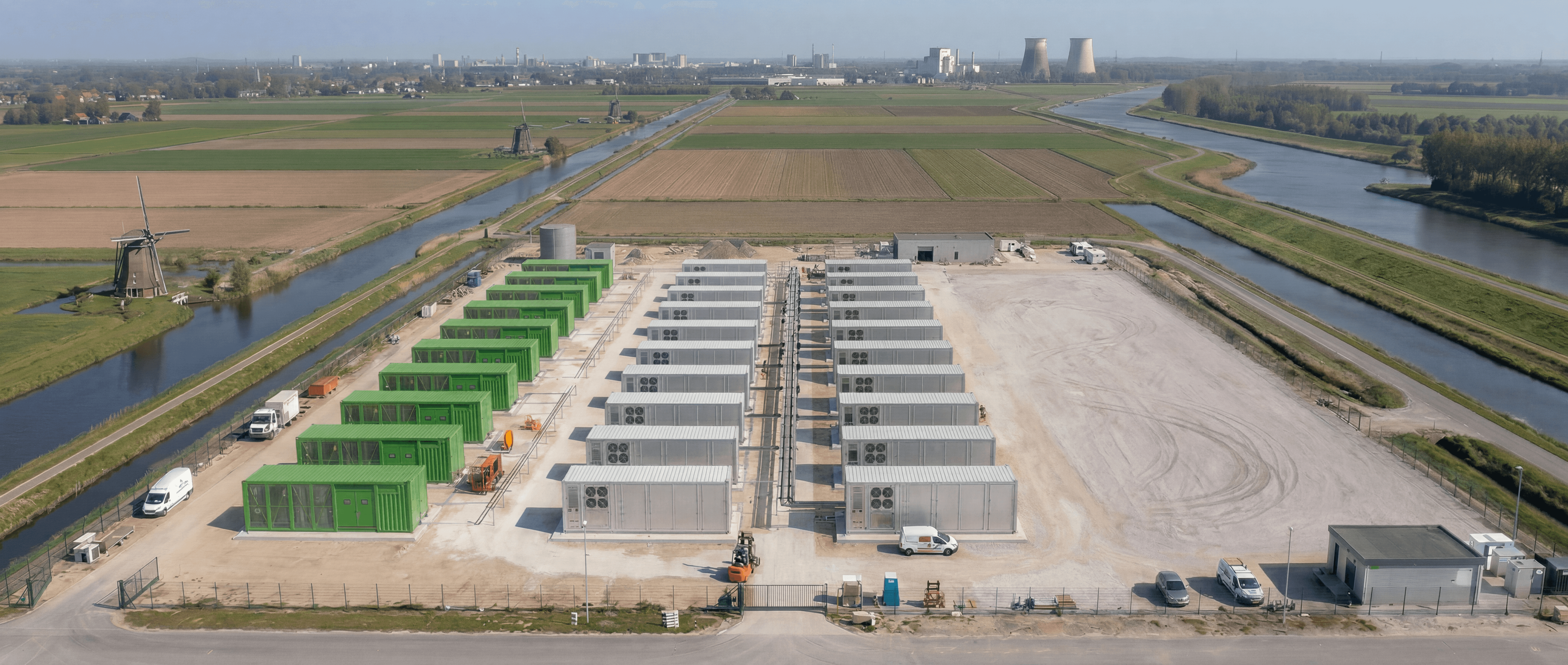
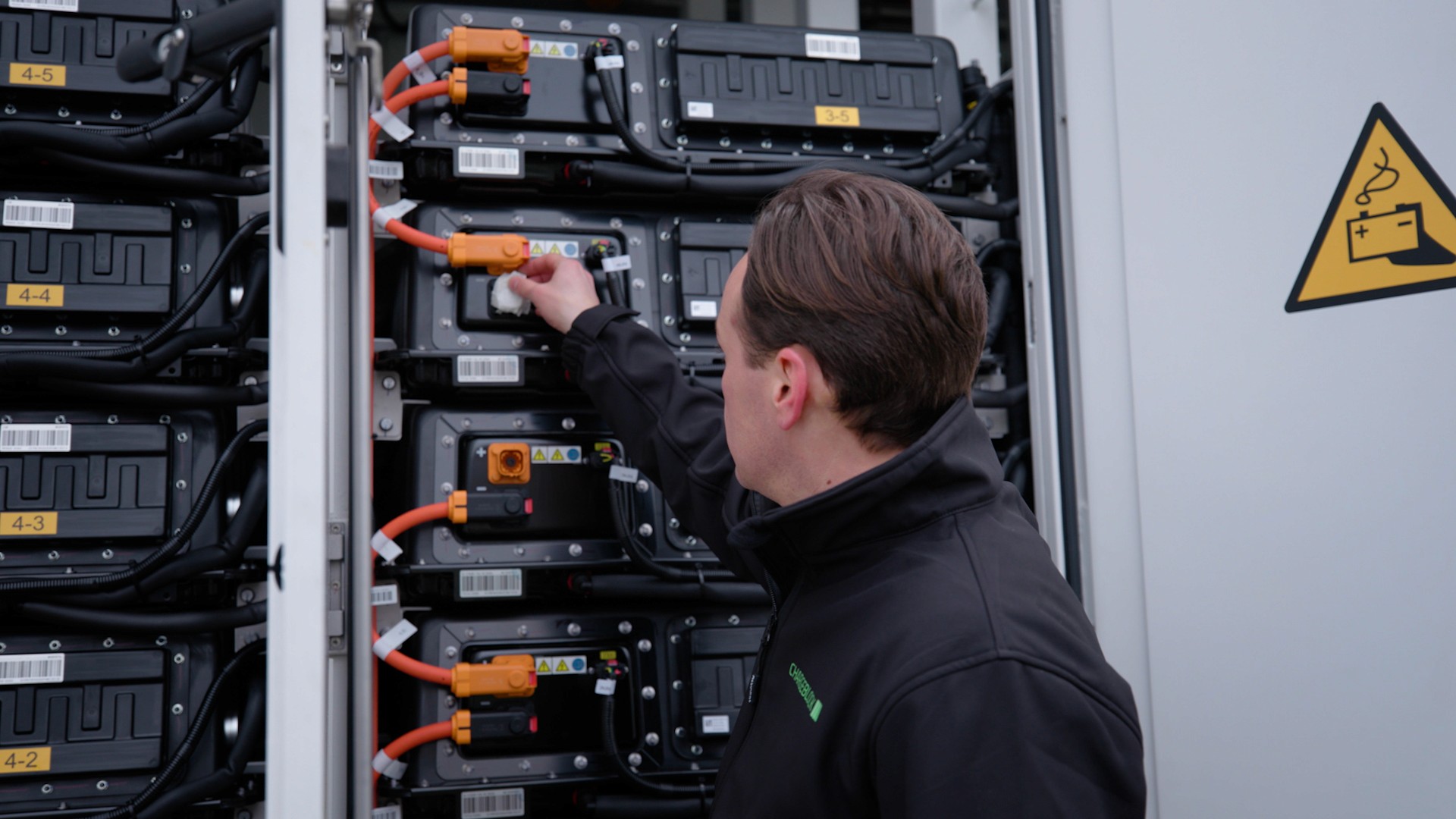
Large-scale energy storage makes the electricity grid more flexible, because energy can be buffered temporarily at the MWh scale and then made available again very quickly. For energy parks, grid operators, and large consumers, this is a key technology for smoothing peaks and troughs in supply and demand, limiting congestion, and making the best possible use of renewable generation. In practice, for ChargeBlock this mainly involves battery energy storage systems (BESS) that provide grid services and create value in energy markets, under strict requirements for safety, availability, and controllability.
Battery containers
ChargeBlock
Large-scale energy storage
Large-scale energy storage makes the electricity grid more flexible, because energy can be buffered temporarily at the MWh scale and then made available again very quickly. For energy parks, grid operators, and large consumers, this is a key technology for smoothing peaks and troughs in supply and demand, limiting congestion, and making the best possible use of renewable generation. In practice, for ChargeBlock this mainly involves battery energy storage systems (BESS) that provide grid services and create value in energy markets, under strict requirements for safety, availability, and controllability.
Battery containers
ChargeBlock
Large-scale energy storage
Large-scale energy storage makes the electricity grid more flexible, because energy can be buffered temporarily at the MWh scale and then made available again very quickly. For energy parks, grid operators, and large consumers, this is a key technology for smoothing peaks and troughs in supply and demand, limiting congestion, and making the best possible use of renewable generation. In practice, for ChargeBlock this mainly involves battery energy storage systems (BESS) that provide grid services and create value in energy markets, under strict requirements for safety, availability, and controllability.
Leading partners

















Leading partners
See how battery storage fits your business.
One-pager for large-scale energy storage
Thank you for your interest. Read the one-pager to see how our solutions can improve your energy management. If you have questions or would like personal advice, please contact us.
Tailored solutions
No standard solutions or white-label imports. ChargeBlock develops and configures battery containers entirely in-house, tailored to application, location, and scale—from individual units to large-scale systems.
System integration
ChargeBlock battery containers integrate easily with existing grid connections, generation, generators, shore power, and EMS platforms. This allows the system to fit directly into your current infrastructure.
Smart energy management
ChargeBlock combines EMS and BMS systems with AI-driven control for real-time monitoring, efficient energy management, and predictive maintenance. Based on consumption, generation, grid conditions, and market prices.
Excellent aftercare
ChargeBlock avoids white-label dependency and keeps critical components in stock. With active monitoring, fast service, and clear guarantees, we minimize downtime.
See how battery storage fits your business.
One-pager for large-scale energy storage
Thank you for your interest. Read the one-pager to see how our solutions can improve your energy management. If you have questions or would like personal advice, please contact us.
Tailored solutions
No standard solutions or white-label imports. ChargeBlock develops and configures battery containers entirely in-house, tailored to application, location, and scale—from individual units to large-scale systems.
System integration
ChargeBlock battery containers integrate easily with existing grid connections, generation, generators, shore power, and EMS platforms. This allows the system to fit directly into your current infrastructure.
Smart energy management
ChargeBlock combines EMS and BMS systems with AI-driven control for real-time monitoring, efficient energy management, and predictive maintenance. Based on consumption, generation, grid conditions, and market prices.
Excellent aftercare
ChargeBlock avoids white-label dependency and keeps critical components in stock. With active monitoring, fast service, and clear guarantees, we minimize downtime.
See how battery storage fits your business.
One-pager for large-scale energy storage
Thank you for your interest. Read the one-pager to see how our solutions can improve your energy management. If you have questions or would like personal advice, please contact us.
Tailored solutions
No standard solutions or white-label imports. ChargeBlock develops and configures battery containers entirely in-house, tailored to application, location, and scale—from individual units to large-scale systems.
System integration
ChargeBlock battery containers integrate easily with existing grid connections, generation, generators, shore power, and EMS platforms. This allows the system to fit directly into your current infrastructure.
Smart energy management
ChargeBlock combines EMS and BMS systems with AI-driven control for real-time monitoring, efficient energy management, and predictive maintenance. Based on consumption, generation, grid conditions, and market prices.
Excellent aftercare
ChargeBlock avoids white-label dependency and keeps critical components in stock. With active monitoring, fast service, and clear guarantees, we minimize downtime.
Why MWh-scale storage is becoming indispensable in the grid
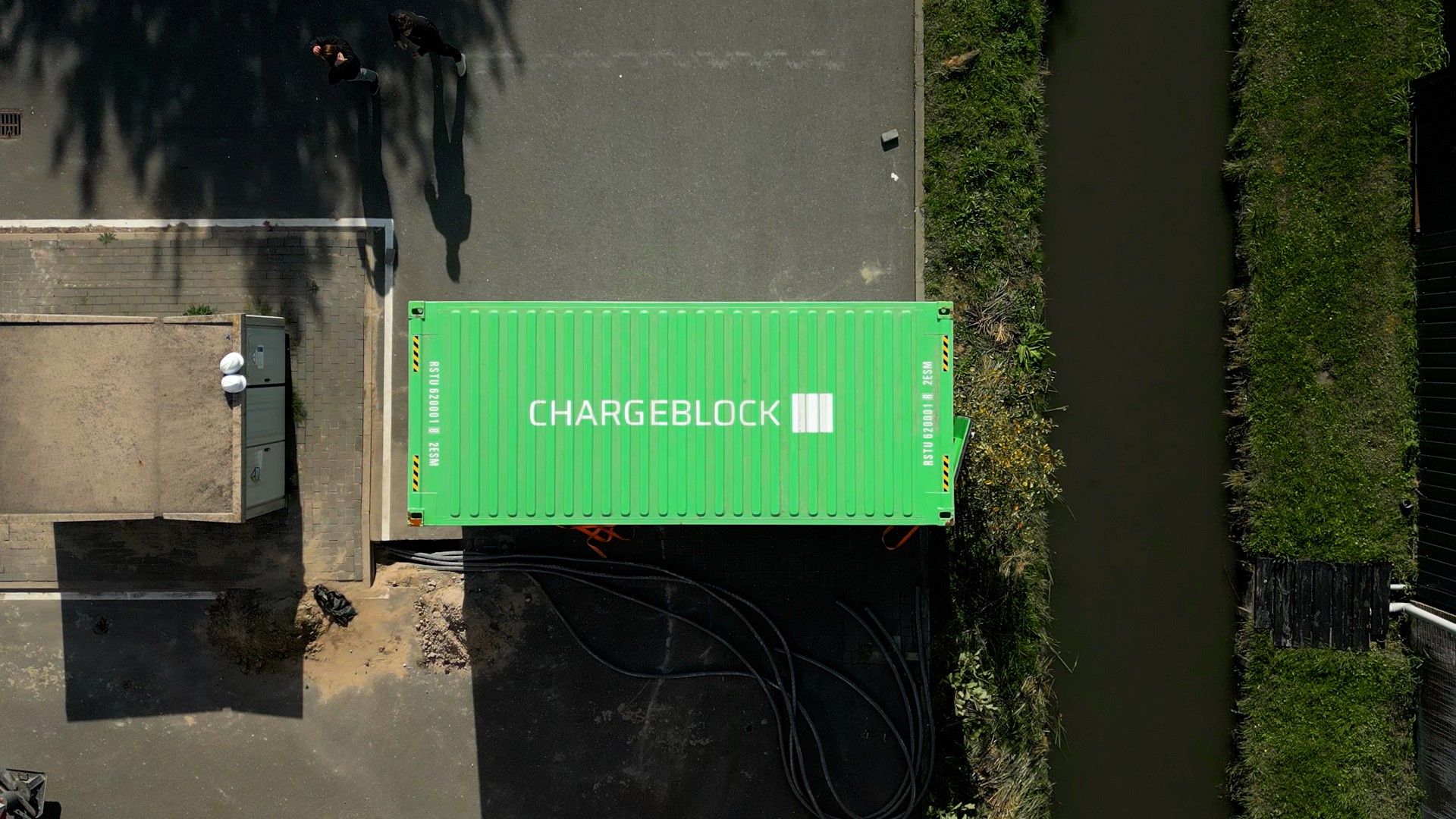
As more wind and solar energy is generated, variation in production increases, while electrification continues to drive demand higher. Without sufficient flexibility, this quickly leads to curtailment (switching off generation), higher imbalance costs, and heavier loading of transformers and cables.
With storage at MWh scale, a site can absorb overproduction and feed it back later, making grid reinforcement less urgent and improving the use of available connection capacity. The specialists at ChargeBlock advise on how a BESS combines fast power response (kW/MW) with energy capacity (MWh), so that both short frequency events and longer price and congestion patterns can be managed.
The most frequently asked questions about battery containers
How does a battery container help with grid congestion and peak load?
Our battery containers are used for peak shaving, zero feed-in, and behind-the-meter optimization. By deploying stored energy intelligently, you prevent exceeding contracted capacity and reduce dependence on the grid. This creates room for expansion without immediate grid reinforcement.
Can the battery container be integrated with our existing EMS or aggregator?
Is battery storage financially feasible for our organization?
Why MWh-scale storage is becoming indispensable in the grid
As more wind and solar energy is generated, variation in production increases, while electrification continues to drive demand higher. Without sufficient flexibility, this quickly leads to curtailment (switching off generation), higher imbalance costs, and heavier loading of transformers and cables.
With storage at MWh scale, a site can absorb overproduction and feed it back later, making grid reinforcement less urgent and improving the use of available connection capacity. The specialists at ChargeBlock advise on how a BESS combines fast power response (kW/MW) with energy capacity (MWh), so that both short frequency events and longer price and congestion patterns can be managed.
The most frequently asked questions about battery containers
How does a battery container help with grid congestion and peak load?
Our battery containers are used for peak shaving, zero feed-in, and behind-the-meter optimization. By deploying stored energy intelligently, you prevent exceeding contracted capacity and reduce dependence on the grid. This creates room for expansion without immediate grid reinforcement.
Can the battery container be integrated with our existing EMS or aggregator?
Is battery storage financially feasible for our organization?
Why MWh-scale storage is becoming indispensable in the grid
As more wind and solar energy is generated, variation in production increases, while electrification continues to drive demand higher. Without sufficient flexibility, this quickly leads to curtailment (switching off generation), higher imbalance costs, and heavier loading of transformers and cables.
With storage at MWh scale, a site can absorb overproduction and feed it back later, making grid reinforcement less urgent and improving the use of available connection capacity. The specialists at ChargeBlock advise on how a BESS combines fast power response (kW/MW) with energy capacity (MWh), so that both short frequency events and longer price and congestion patterns can be managed.
The most frequently asked questions about battery containers
How does a battery container help with grid congestion and peak load?
Our battery containers are used for peak shaving, zero feed-in, and behind-the-meter optimization. By deploying stored energy intelligently, you prevent exceeding contracted capacity and reduce dependence on the grid. This creates room for expansion without immediate grid reinforcement.
Can the battery container be integrated with our existing EMS or aggregator?
Is battery storage financially feasible for our organization?
Grid stabilization with FCR, aFRR and fast power response
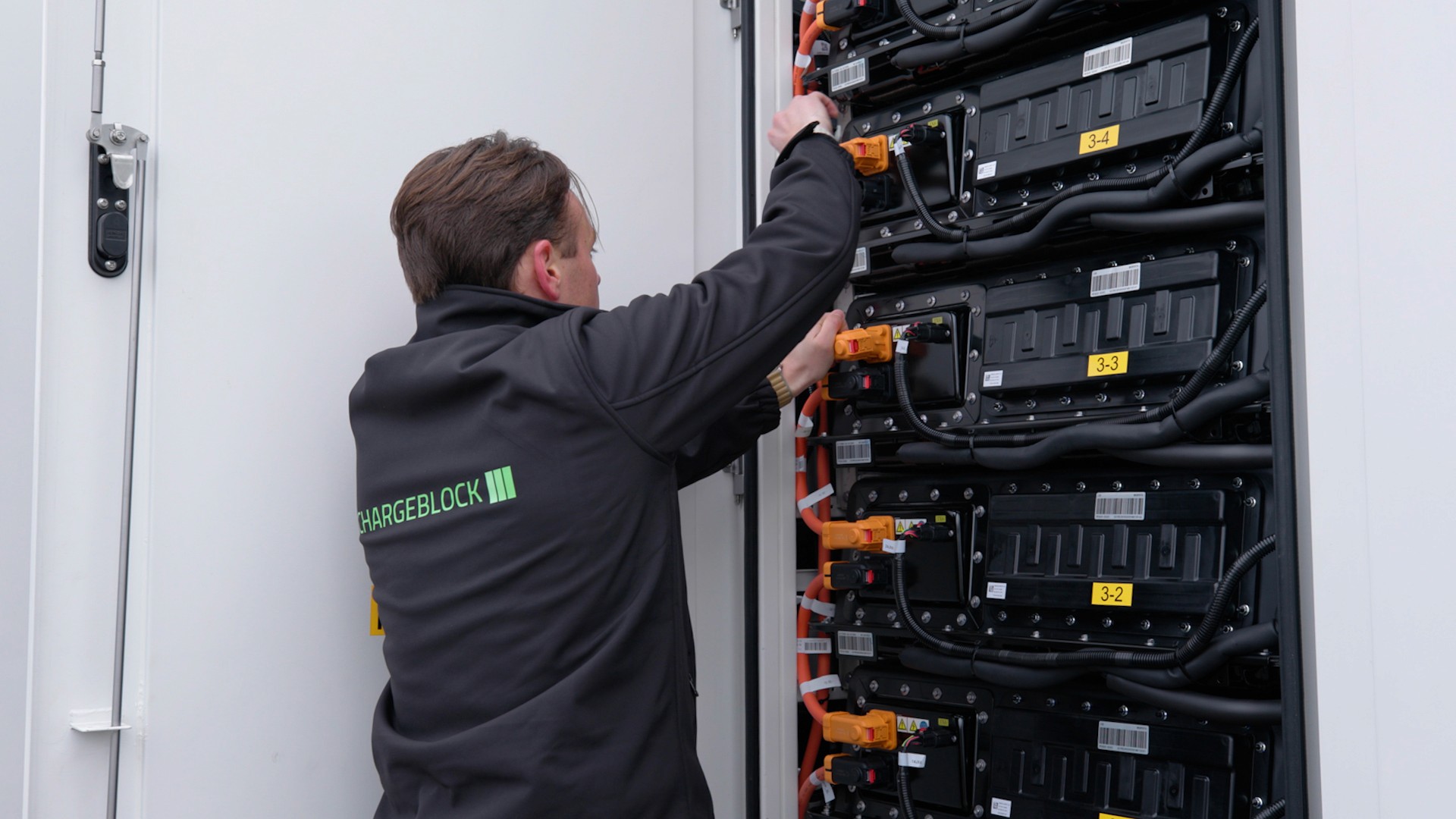
Because batteries can respond within milliseconds to seconds, they are highly suitable for frequency control. In FCR (Frequency Containment Reserve), the system automatically stabilizes grid frequency around 50 Hz. With aFRR (automatic Frequency Restoration Reserve), power is then dynamically adjusted to restore the balance between production and consumption.
In this context, state-of-charge management, round-trip efficiency, degradation, and availability are decisive: a BESS must be able to charge and discharge within contractual limits, while at the same time sufficient stored energy must remain available to support longer activations.
Grid stabilization with FCR, aFRR and fast power response
Because batteries can respond within milliseconds to seconds, they are highly suitable for frequency control. In FCR (Frequency Containment Reserve), the system automatically stabilizes grid frequency around 50 Hz. With aFRR (automatic Frequency Restoration Reserve), power is then dynamically adjusted to restore the balance between production and consumption.
In this context, state-of-charge management, round-trip efficiency, degradation, and availability are decisive: a BESS must be able to charge and discharge within contractual limits, while at the same time sufficient stored energy must remain available to support longer activations.
Grid stabilization with FCR, aFRR and fast power response
Because batteries can respond within milliseconds to seconds, they are highly suitable for frequency control. In FCR (Frequency Containment Reserve), the system automatically stabilizes grid frequency around 50 Hz. With aFRR (automatic Frequency Restoration Reserve), power is then dynamically adjusted to restore the balance between production and consumption.
In this context, state-of-charge management, round-trip efficiency, degradation, and availability are decisive: a BESS must be able to charge and discharge within contractual limits, while at the same time sufficient stored energy must remain available to support longer activations.
Trading markets: imbalance, arbitrage and energy management
In addition to grid services, storage can also generate revenue through market optimization. In imbalance trading, deviations between forecast and actual production or consumption are used; a battery can immediately compensate for shortages or absorb surpluses. In arbitrage, it is charged when the price is low and discharged when the price is high, for example based on day-ahead, intraday, or quarter-hour prices.
The final return depends on the spread, the number of cycles, and practical constraints, such as grid or export limits. ChargeBlock supports the choice of forecasting and an EMS (Energy Management System) to determine whether strategies reinforce each other or instead compete for the same capacity.
Trading markets: imbalance, arbitrage and energy management
In addition to grid services, storage can also generate revenue through market optimization. In imbalance trading, deviations between forecast and actual production or consumption are used; a battery can immediately compensate for shortages or absorb surpluses. In arbitrage, it is charged when the price is low and discharged when the price is high, for example based on day-ahead, intraday, or quarter-hour prices.
The final return depends on the spread, the number of cycles, and practical constraints, such as grid or export limits. ChargeBlock supports the choice of forecasting and an EMS (Energy Management System) to determine whether strategies reinforce each other or instead compete for the same capacity.
Trading markets: imbalance, arbitrage and energy management
In addition to grid services, storage can also generate revenue through market optimization. In imbalance trading, deviations between forecast and actual production or consumption are used; a battery can immediately compensate for shortages or absorb surpluses. In arbitrage, it is charged when the price is low and discharged when the price is high, for example based on day-ahead, intraday, or quarter-hour prices.
The final return depends on the spread, the number of cycles, and practical constraints, such as grid or export limits. ChargeBlock supports the choice of forecasting and an EMS (Energy Management System) to determine whether strategies reinforce each other or instead compete for the same capacity.
System architecture: from battery container to grid connection
A utility-scale BESS consists of battery modules, a power conversion system (inverters), a transformer, protection systems, and controls. In many projects, a ChargeBlock battery container serves as the modular building block, being scalable, transportable, and typically designed for outdoor installation.
The design is heavily influenced by decisions regarding AC or DC coupling, redundancy, cooling (HVAC or liquid), fire detection and suppression, and the interface with the medium-voltage grid connection. This also involves protection studies and compliance with grid codes. In addition, measurement and telemetry requirements from TSOs/DSOs and market platforms often dictate the final configuration.
Want to learn more about what a BESS is and what capacities are available? View our BESS page.
System architecture: from battery container to grid connection
A utility-scale BESS consists of battery modules, a power conversion system (inverters), a transformer, protection systems, and controls. In many projects, a ChargeBlock battery container serves as the modular building block, being scalable, transportable, and typically designed for outdoor installation.
The design is heavily influenced by decisions regarding AC or DC coupling, redundancy, cooling (HVAC or liquid), fire detection and suppression, and the interface with the medium-voltage grid connection. This also involves protection studies and compliance with grid codes. In addition, measurement and telemetry requirements from TSOs/DSOs and market platforms often dictate the final configuration.
Want to learn more about what a BESS is and what capacities are available? View our BESS page.
System architecture: from battery container to grid connection
A utility-scale BESS consists of battery modules, a power conversion system (inverters), a transformer, protection systems, and controls. In many projects, a ChargeBlock battery container serves as the modular building block, being scalable, transportable, and typically designed for outdoor installation.
The design is heavily influenced by decisions regarding AC or DC coupling, redundancy, cooling (HVAC or liquid), fire detection and suppression, and the interface with the medium-voltage grid connection. This also involves protection studies and compliance with grid codes. In addition, measurement and telemetry requirements from TSOs/DSOs and market platforms often dictate the final configuration.
Want to learn more about what a BESS is and what capacities are available? View our BESS page.
Why ChargeBlock
The benefits
of ChargeBlock
At ChargeBlock, customer satisfaction comes first. We develop and supply battery containers for companies that want control over energy—technically, operationally, and financially.
Tailored solutions
No standard solutions or white-label imports. ChargeBlock develops and configures battery containers entirely in-house, tailored to application, location, and scale—from individual units to large-scale systems.
System integration
ChargeBlock battery containers integrate easily with existing grid connections, generation, generators, shore power, and EMS platforms. This allows the system to fit directly into your current infrastructure.
Smart energy management
ChargeBlock combines EMS and BMS systems with AI-driven control for real-time monitoring, efficient energy management, and predictive maintenance. Based on consumption, generation, grid conditions, and market prices.
Excellent aftercare
ChargeBlock avoids white-label dependency and keeps critical components in stock. With active monitoring, fast service, and clear guarantees, we minimize downtime.
Why ChargeBlock
The benefits
of ChargeBlock
At ChargeBlock, customer satisfaction comes first. We develop and supply battery containers for companies that want control over energy—technically, operationally, and financially.
Tailored solutions
No standard solutions or white-label imports. ChargeBlock develops and configures battery containers entirely in-house, tailored to application, location, and scale—from individual units to large-scale systems.
System integration
ChargeBlock battery containers integrate easily with existing grid connections, generation, generators, shore power, and EMS platforms. This allows the system to fit directly into your current infrastructure.
Smart energy management
ChargeBlock combines EMS and BMS systems with AI-driven control for real-time monitoring, efficient energy management, and predictive maintenance. Based on consumption, generation, grid conditions, and market prices.
Excellent aftercare
ChargeBlock avoids white-label dependency and keeps critical components in stock. With active monitoring, fast service, and clear guarantees, we minimize downtime.
Why ChargeBlock
The benefits
of ChargeBlock
At ChargeBlock, customer satisfaction comes first. We develop and supply battery containers for companies that want control over energy—technically, operationally, and financially.
Tailored solutions
No standard solutions or white-label imports. ChargeBlock develops and configures battery containers entirely in-house, tailored to application, location, and scale—from individual units to large-scale systems.
System integration
ChargeBlock battery containers integrate easily with existing grid connections, generation, generators, shore power, and EMS platforms. This allows the system to fit directly into your current infrastructure.
Smart energy management
ChargeBlock combines EMS and BMS systems with AI-driven control for real-time monitoring, efficient energy management, and predictive maintenance. Based on consumption, generation, grid conditions, and market prices.
Excellent aftercare
ChargeBlock avoids white-label dependency and keeps critical components in stock. With active monitoring, fast service, and clear guarantees, we minimize downtime.

Safety, permits, and service life: where projects fail or succeed
In terms of safety, the main focus is on controlling the risk of thermal runaway, with attention to compartmentalization, ventilation, fire suppression concepts, and clear incident response procedures. Permitting processes generally require substantiation of noise levels, spatial integration, grid impact, and external safety aspects.
For the business case, degradation, warranty conditions, maintenance, and availability are decisive. By applying realistic dispatch that takes temperature, C-rate, SoC windows, and connection limitations into account, ChargeBlock helps maintain service life for longer and prevent revenue from FCR/aFRR or arbitrage from declining due to unexpected derating.
This makes large-scale energy storage both a grid instrument and a market asset: those who design the system integrally and control it intelligently with ChargeBlock limit curtailment, reduce imbalance risk, and strengthen grid stability.
Safety, permits, and service life: where projects fail or succeed
In terms of safety, the main focus is on controlling the risk of thermal runaway, with attention to compartmentalization, ventilation, fire suppression concepts, and clear incident response procedures. Permitting processes generally require substantiation of noise levels, spatial integration, grid impact, and external safety aspects.
For the business case, degradation, warranty conditions, maintenance, and availability are decisive. By applying realistic dispatch that takes temperature, C-rate, SoC windows, and connection limitations into account, ChargeBlock helps maintain service life for longer and prevent revenue from FCR/aFRR or arbitrage from declining due to unexpected derating.
This makes large-scale energy storage both a grid instrument and a market asset: those who design the system integrally and control it intelligently with ChargeBlock limit curtailment, reduce imbalance risk, and strengthen grid stability.
Safety, permits, and service life: where projects fail or succeed
In terms of safety, the main focus is on controlling the risk of thermal runaway, with attention to compartmentalization, ventilation, fire suppression concepts, and clear incident response procedures. Permitting processes generally require substantiation of noise levels, spatial integration, grid impact, and external safety aspects.
For the business case, degradation, warranty conditions, maintenance, and availability are decisive. By applying realistic dispatch that takes temperature, C-rate, SoC windows, and connection limitations into account, ChargeBlock helps maintain service life for longer and prevent revenue from FCR/aFRR or arbitrage from declining due to unexpected derating.
This makes large-scale energy storage both a grid instrument and a market asset: those who design the system integrally and control it intelligently with ChargeBlock limit curtailment, reduce imbalance risk, and strengthen grid stability.

and scalable battery storage
Customer service
Solutions
Subscribe to our newsletter to stay informed.
By signing up, you agree to the privacy statement and the general terms and conditions of ChargeBlock B.V. You can unsubscribe at any time.
Rated
4.8/5.0

Developed
in the Netherlands

and scalable battery storage
Customer service
Solutions
Subscribe to our newsletter to stay informed.
By signing up, you agree to the privacy statement and the general terms and conditions of ChargeBlock B.V. You can unsubscribe at any time.
Rated
4.8/5.0
Developed
in the Netherlands
and scalable battery storage
Customer service
Solutions
Subscribe to our newsletter to stay informed.
By signing up, you agree to the privacy statement and the general terms and conditions of ChargeBlock B.V. You can unsubscribe at any time.
Rated
4.8/5.0
Developed
in the Netherlands
