
Requests
Request our quote, brochures, or product catalog below at no cost. Within minutes, you will receive all the required details in your inbox.
Requests
Request our quote, brochures, or product catalog below at no cost. Within minutes, you will receive all the required details in your inbox.
Requests
Request our quote, brochures, or product catalog below at no cost. Within minutes, you will receive all the required details in your inbox.
Leading partners
















Leading partners
Choose what you want to request here
Battery container
Quote
Here you can request a quote for a battery container. You will receive a tailored proposal in your inbox within 48 hours.
Battery container
Introductory brochure
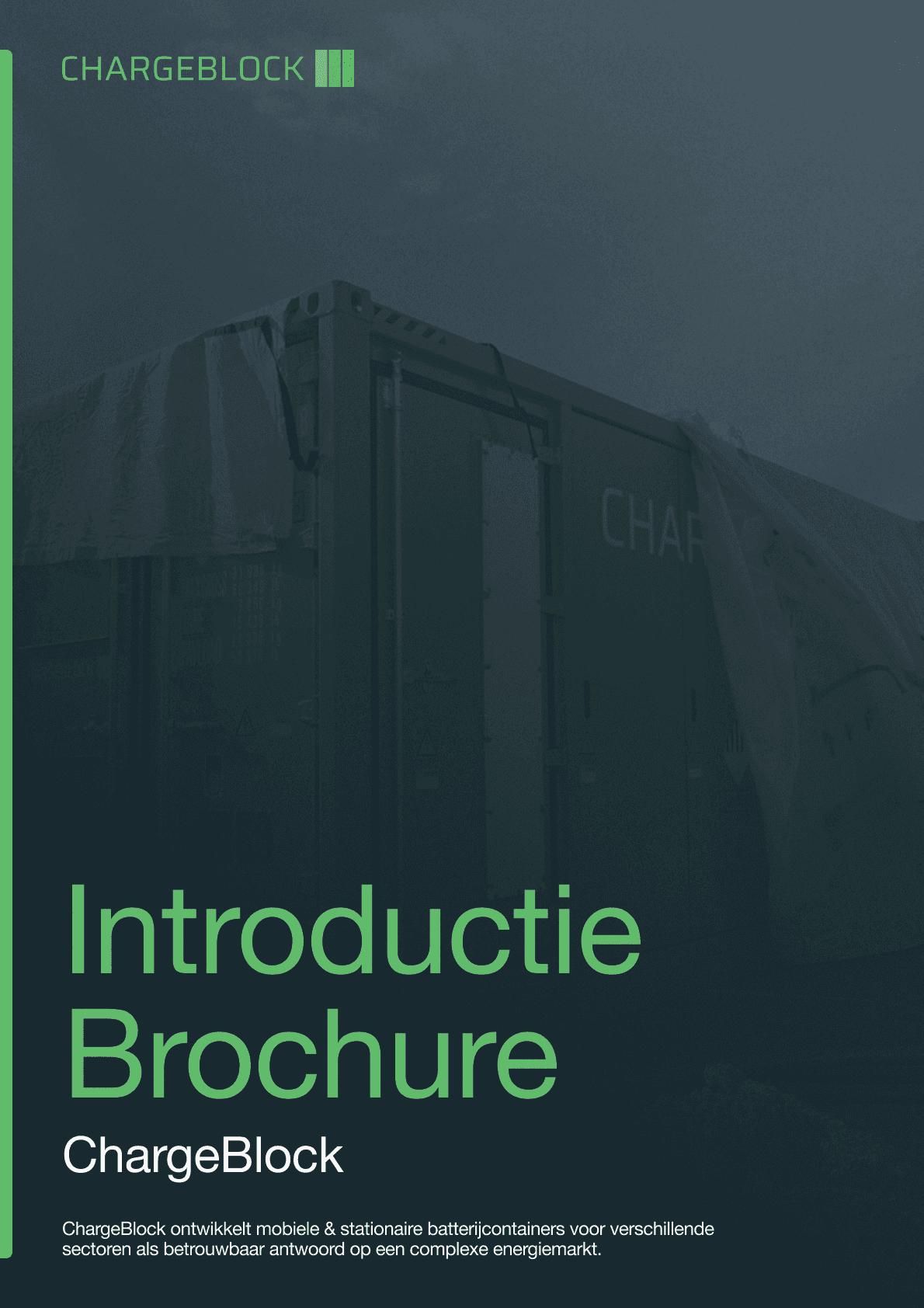
Read the introductory brochure free of charge and see how our solutions can improve your energy management.
White paper
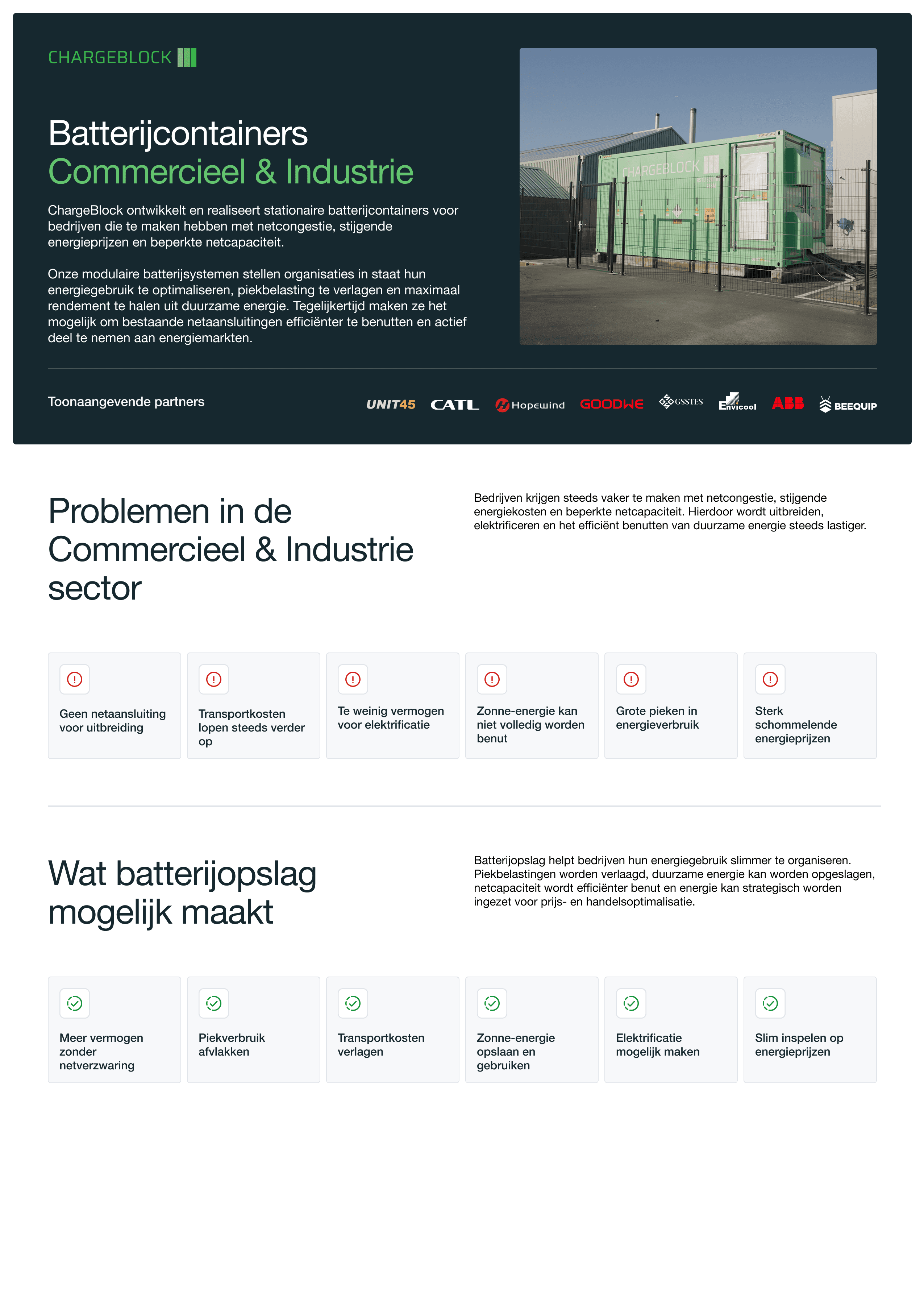
Commercial & Industrial
ChargeBlock develops and delivers stationary battery containers for companies facing grid congestion, rising energy prices, and limited grid capacity.
White paper
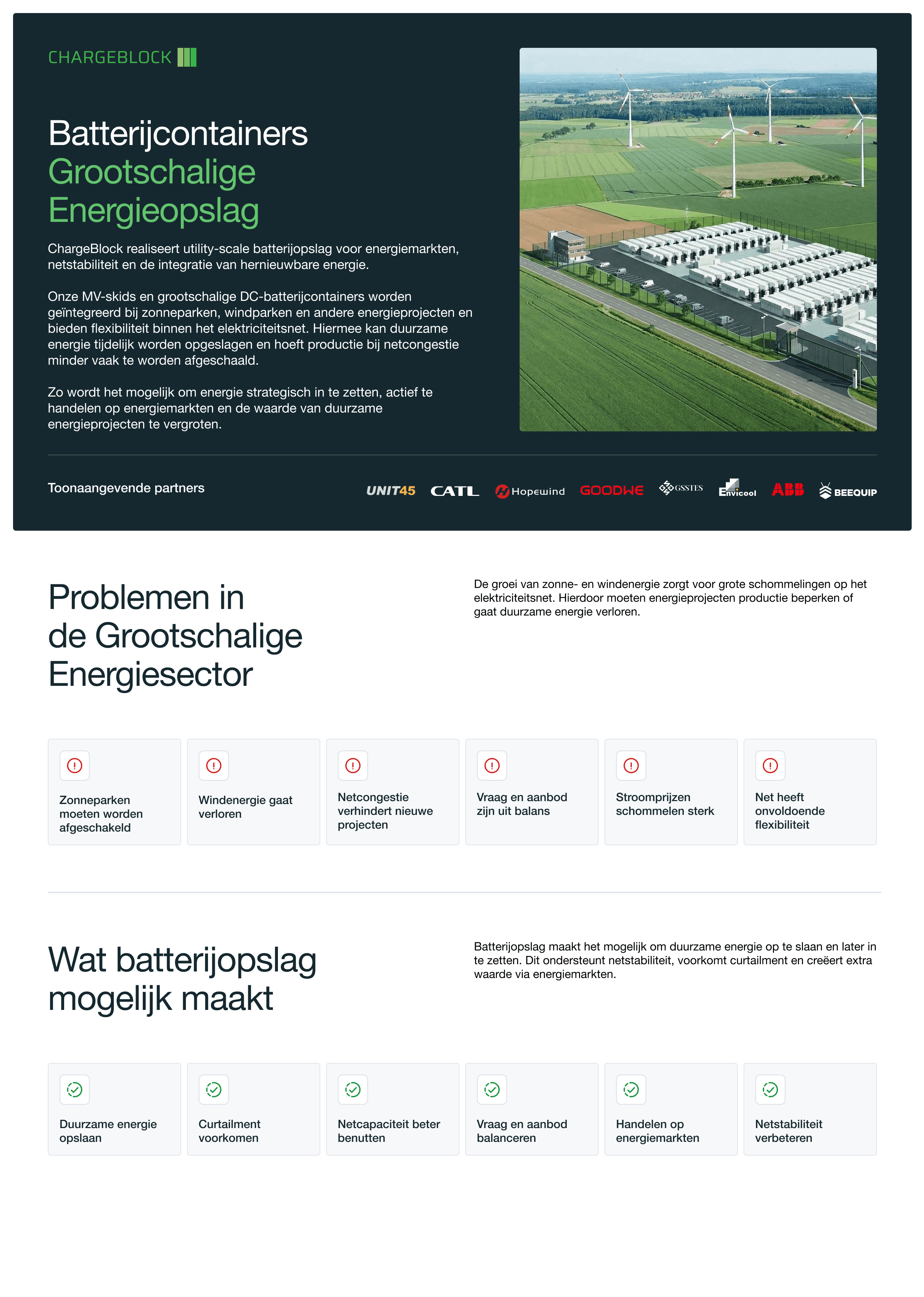
Large-scale Energy Storage
ChargeBlock delivers utility-scale battery storage for energy markets, grid stability, and the integration of renewable energy.
White paper
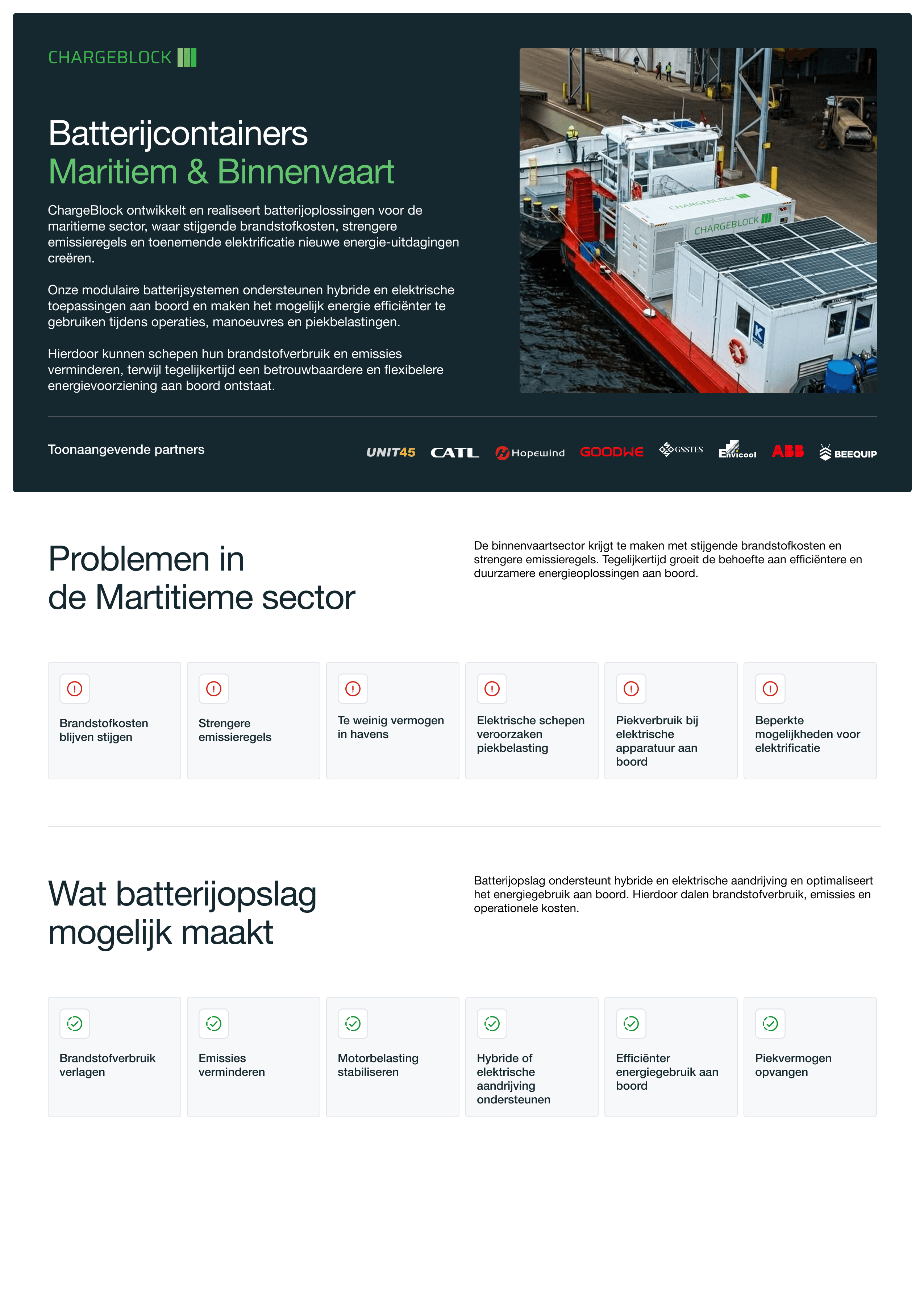
Maritime & Inland Shipping
ChargeBlock develops and delivers battery solutions for the maritime sector, where rising fuel costs, stricter emissions regulations, and increasing electrification create new energy challenges.
White paper
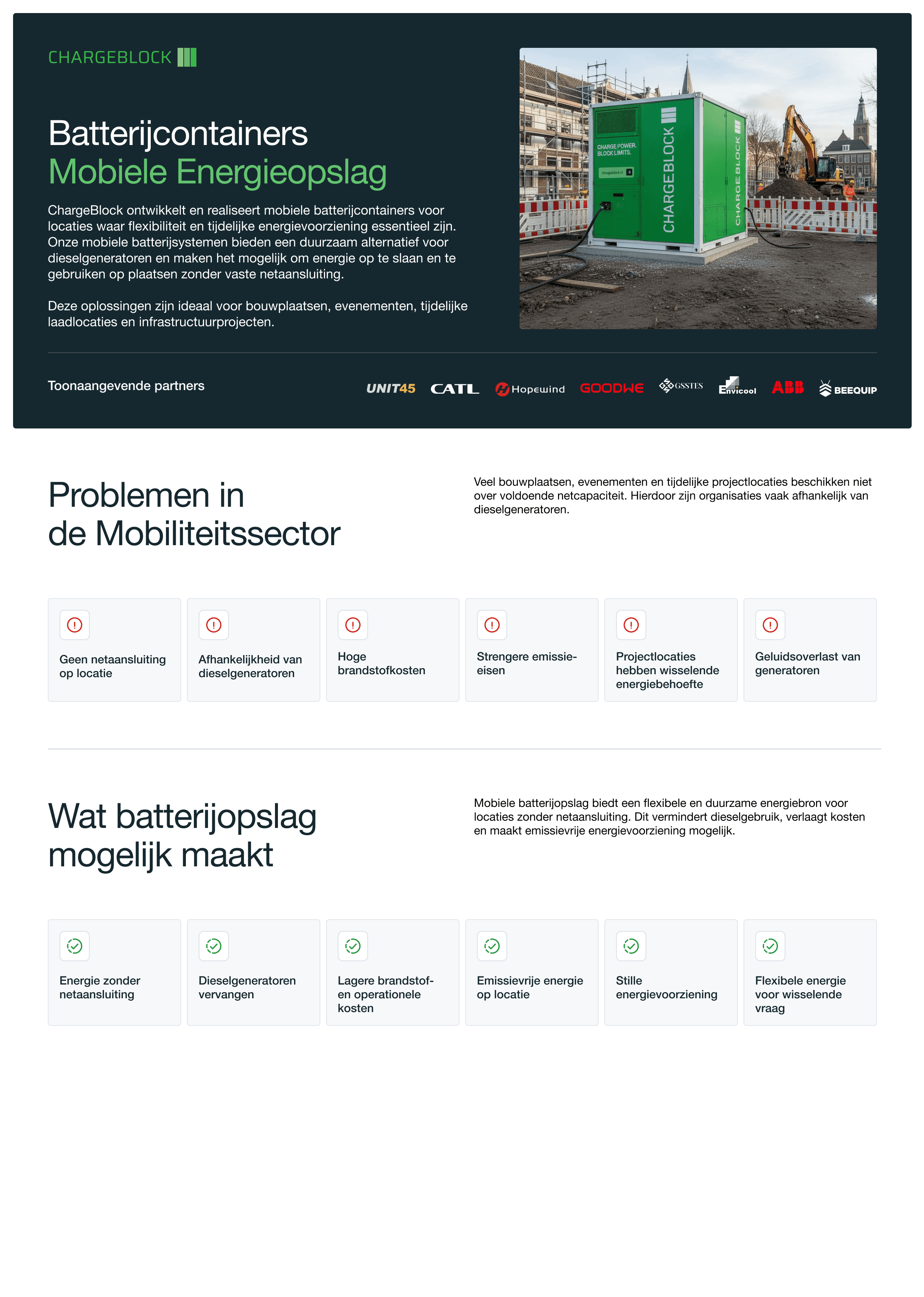
Mobile Energy Storage
ChargeBlock develops and delivers mobile battery containers for locations where flexibility and temporary power supply are essential.

The benefits of ChargeBlock
At ChargeBlock, customer satisfaction comes first. Through our services and warranties, we ensure you can use our products without concern.
Tailored solutions
No standard solutions or white-label imports. ChargeBlock develops and configures battery containers entirely in-house, tailored to application, location, and scale—from individual units to large-scale systems.
System integration
ChargeBlock battery containers integrate easily with existing grid connections, generation, generators, shore power, and EMS platforms. This allows the system to fit directly into your current infrastructure.
Smart energy management
ChargeBlock combines EMS and BMS systems with AI-driven control for real-time monitoring, efficient energy management, and predictive maintenance. Based on consumption, generation, grid conditions, and market prices.
Excellent aftercare
ChargeBlock avoids white-label dependency and keeps critical components in stock. With active monitoring, fast service, and clear guarantees, we minimize downtime.
Joep Koolen
CCO
Choose what you want to request here
Battery container
Quote
Here you can request a quote for a battery container. You will receive a tailored proposal in your inbox within 48 hours.
Battery container
Introductory brochure
Read the introductory brochure free of charge and see how our solutions can improve your energy management.
Whitepaper
Commercial & Industrial
ChargeBlock develops and delivers stationary battery containers for companies facing grid congestion, rising energy prices, and limited grid capacity.
Whitepaper
Large-scale Energy Storage
ChargeBlock delivers utility-scale battery storage for energy markets, grid stability, and the integration of renewable energy.
Whitepaper
Maritime & Inland Shipping
ChargeBlock develops and delivers battery solutions for the maritime sector, where rising fuel costs, stricter emissions regulations, and increasing electrification create new energy challenges.
Whitepaper
Mobile Energy Storage
ChargeBlock develops and delivers mobile battery containers for locations where flexibility and temporary power supply are essential.
The benefits of ChargeBlock
At ChargeBlock, customer satisfaction comes first. Through our services and warranties, we ensure you can use our products without concern.
Tailored solutions
No standard solutions or white-label imports. ChargeBlock develops and configures battery containers entirely in-house, tailored to application, location, and scale—from individual units to large-scale systems.
System integration
ChargeBlock battery containers integrate easily with existing grid connections, generation, generators, shore power, and EMS platforms. This allows the system to fit directly into your current infrastructure.
Smart energy management
ChargeBlock combines EMS and BMS systems with AI-driven control for real-time monitoring, efficient energy management, and predictive maintenance. Based on consumption, generation, grid conditions, and market prices.
Excellent aftercare
ChargeBlock avoids white-label dependency and keeps critical components in stock. With active monitoring, fast service, and clear guarantees, we minimize downtime.
Choose what you want to request here
Battery container
Quote
Here you can request a quote for a battery container. You will receive a tailored proposal in your inbox within 48 hours.
Battery container
Introductory brochure
Read the introductory brochure free of charge and see how our solutions can improve your energy management.
Whitepaper
Commercial & Industrial
ChargeBlock develops and delivers stationary battery containers for companies facing grid congestion, rising energy prices, and limited grid capacity.
Whitepaper
Large-scale Energy Storage
ChargeBlock delivers utility-scale battery storage for energy markets, grid stability, and the integration of renewable energy.
Whitepaper
Maritime & Inland Shipping
ChargeBlock develops and delivers battery solutions for the maritime sector, where rising fuel costs, stricter emissions regulations, and increasing electrification create new energy challenges.
Whitepaper
Mobile Energy Storage
ChargeBlock develops and delivers mobile battery containers for locations where flexibility and temporary power supply are essential.
The benefits of ChargeBlock
At ChargeBlock, customer satisfaction comes first. Through our services and warranties, we ensure you can use our products without concern.
Tailored solutions
No standard solutions or white-label imports. ChargeBlock develops and configures battery containers entirely in-house, tailored to application, location, and scale—from individual units to large-scale systems.
System integration
ChargeBlock battery containers integrate easily with existing grid connections, generation, generators, shore power, and EMS platforms. This allows the system to fit directly into your current infrastructure.
Smart energy management
ChargeBlock combines EMS and BMS systems with AI-driven control for real-time monitoring, efficient energy management, and predictive maintenance. Based on consumption, generation, grid conditions, and market prices.
Excellent aftercare
ChargeBlock avoids white-label dependency and keeps critical components in stock. With active monitoring, fast service, and clear guarantees, we minimize downtime.
Joep Koolen
CCO
Frequently asked questions
Here you will find answers to the most common questions.
Is it not listed?
Are requests per document free?
Yes, all requests for a quotation, brochure, product catalog, and calculation are free of charge. This is part of our service, as are a consultation and site visit. In this way, we aim to differentiate ourselves by providing customers with as much honest and transparent information as possible before a decision has to be made.
What content can I expect per document?
• Quotation
A tailored price proposal aligned with your request. Includes an estimate of installation and maintenance costs, based on comparable completed projects.
• Brochure
Explanation of the origins and partners of ChargeBlock, our developed products, and applications of battery containers. Also includes information on certifications, integration with EMS and aggregator platforms, and visual presentations of our systems.
• Product catalog
A complete overview of all available models, including technical specifications, power ratings, dimensions, and weights.
• Calculation
A personal analysis based on your energy consumption data, with an estimate of required capacity, expected return, and payback period.
What is the difference between the quotation, brochure, product catalog, and calculation?
• Quotation: complete tailored price proposal.
• Brochure: general explanation of applications and benefits of ChargeBlock.
• Product catalog: technical specifications and models.
• Calculation: analysis of your consumption and battery capacity.
How quickly will I receive my document or response?
• Quotation
You will immediately receive a confirmation email. A tailored quotation will follow within 48 hours.
• Brochure and product catalog
You will receive these immediately by email after submitting your request.
• Calculation
You will immediately receive a confirmation email. If all data is complete, we will send a tailored calculation within 5 working days. If data is missing, we will contact you within 1 working day to complete it.
Can I provide additional data later for a more accurate calculation?
Yes, you can always send additional information (such as quarter-hour data or a consumption profile). Our team can then refine the calculation or send a tailored proposal.
What do I need to request a calculation?
For an accurate calculation, we request basic information about your energy consumption, such as gross quarter-hour data, contracted capacities, the intended objective, and any future changes in the consumption profile.
Can I request multiple documents at the same time?
No, at the moment you need to request each type of document separately, because different relevant questions are asked for each type of request. You will receive a separate email for each document.
Is my application shared with third parties?
No, your data is used solely to prepare your documents and is not shared with third parties.
Frequently asked questions
Here you will find answers to the most common questions.
Is it not listed?
Are requests per document free?
Yes, all requests for a quotation, brochure, product catalog, and calculation are free of charge. This is part of our service, as are a consultation and site visit. In this way, we aim to differentiate ourselves by providing customers with as much honest and transparent information as possible before a decision has to be made.
What content can I expect per document?
• Quotation
A tailored price proposal aligned with your request. Includes an estimate of installation and maintenance costs, based on comparable completed projects.
• Brochure
Explanation of the origins and partners of ChargeBlock, our developed products, and applications of battery containers. Also includes information on certifications, integration with EMS and aggregator platforms, and visual presentations of our systems.
• Product catalog
A complete overview of all available models, including technical specifications, power ratings, dimensions, and weights.
• Calculation
A personal analysis based on your energy consumption data, with an estimate of required capacity, expected return, and payback period.
What is the difference between the quotation, brochure, product catalog, and calculation?
• Quotation: complete tailored price proposal.
• Brochure: general explanation of applications and benefits of ChargeBlock.
• Product catalog: technical specifications and models.
• Calculation: analysis of your consumption and battery capacity.
How quickly will I receive my document or response?
• Quotation
You will immediately receive a confirmation email. A tailored quotation will follow within 48 hours.
• Brochure and product catalog
You will receive these immediately by email after submitting your request.
• Calculation
You will immediately receive a confirmation email. If all data is complete, we will send a tailored calculation within 5 working days. If data is missing, we will contact you within 1 working day to complete it.
Can I provide additional data later for a more accurate calculation?
Yes, you can always send additional information (such as quarter-hour data or a consumption profile). Our team can then refine the calculation or send a tailored proposal.
What do I need to request a calculation?
For an accurate calculation, we request basic information about your energy consumption, such as gross quarter-hour data, contracted capacities, the intended objective, and any future changes in the consumption profile.
Can I request multiple documents at the same time?
No, at the moment you need to request each type of document separately, because different relevant questions are asked for each type of request. You will receive a separate email for each document.
Is my application shared with third parties?
No, your data is used solely to prepare your documents and is not shared with third parties.
Frequently asked questions
Here you will find answers to the most common questions.
Is it not listed?
Are requests per document free?
Yes, all requests for a quotation, brochure, product catalog, and calculation are free of charge. This is part of our service, as are a consultation and site visit. In this way, we aim to differentiate ourselves by providing customers with as much honest and transparent information as possible before a decision has to be made.
What content can I expect per document?
• Quotation
A tailored price proposal aligned with your request. Includes an estimate of installation and maintenance costs, based on comparable completed projects.
• Brochure
Explanation of the origins and partners of ChargeBlock, our developed products, and applications of battery containers. Also includes information on certifications, integration with EMS and aggregator platforms, and visual presentations of our systems.
• Product catalog
A complete overview of all available models, including technical specifications, power ratings, dimensions, and weights.
• Calculation
A personal analysis based on your energy consumption data, with an estimate of required capacity, expected return, and payback period.
What is the difference between the quotation, brochure, product catalog, and calculation?
• Quotation: complete tailored price proposal.
• Brochure: general explanation of applications and benefits of ChargeBlock.
• Product catalog: technical specifications and models.
• Calculation: analysis of your consumption and battery capacity.
How quickly will I receive my document or response?
• Quotation
You will immediately receive a confirmation email. A tailored quotation will follow within 48 hours.
• Brochure and product catalog
You will receive these immediately by email after submitting your request.
• Calculation
You will immediately receive a confirmation email. If all data is complete, we will send a tailored calculation within 5 working days. If data is missing, we will contact you within 1 working day to complete it.
Can I provide additional data later for a more accurate calculation?
Yes, you can always send additional information (such as quarter-hour data or a consumption profile). Our team can then refine the calculation or send a tailored proposal.
What do I need to request a calculation?
For an accurate calculation, we request basic information about your energy consumption, such as gross quarter-hour data, contracted capacities, the intended objective, and any future changes in the consumption profile.
Can I request multiple documents at the same time?
No, at the moment you need to request each type of document separately, because different relevant questions are asked for each type of request. You will receive a separate email for each document.
Is my application shared with third parties?
No, your data is used solely to prepare your documents and is not shared with third parties.
and scalable battery storage
Customer service
Solutions
Subscribe to our newsletter to stay informed.
By signing up, you agree to the privacy statement and the general terms and conditions of ChargeBlock B.V. You can unsubscribe at any time.
Rated
4.8/5.0

Developed
in the Netherlands

and scalable battery storage
Customer service
Solutions
Subscribe to our newsletter to stay informed.
By signing up, you agree to the privacy statement and the general terms and conditions of ChargeBlock B.V. You can unsubscribe at any time.
Rated
4.8/5.0
Developed
in the Netherlands
and scalable battery storage
Customer service
Solutions
Subscribe to our newsletter to stay informed.
By signing up, you agree to the privacy statement and the general terms and conditions of ChargeBlock B.V. You can unsubscribe at any time.
Rated
4.8/5.0
Developed
in the Netherlands